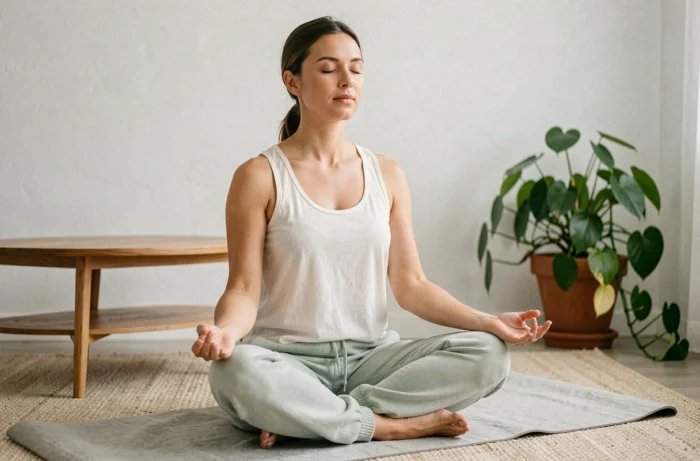
We come home from work, jaws clenched, shoulders raised to our ears, and the evening goes by without us having truly recovered. The next day, it’s the same story. Relaxation techniques against stress are not meant to “feel better” in the abstract: they aim to break this cycle of accumulated tension before it causes measurable physical damage.
Sleep disorders, chronic pain, immune fatigue: the consequences are tangible. One must also choose the right method for their situation and stick with it long enough to reap real benefits.
Controlled breathing at the office: the technique that works in acute stress situations
We are in a meeting, tensions rise, heart rate spikes. No yoga posture is possible at that moment. What remains accessible is breathing.
The principle is simple: extend the exhalation compared to the inhalation. Inhale for four counts through the nose, exhale for six to eight counts through the mouth. This asymmetry activates the parasympathetic nervous system, which slows down the stress response. The effect is felt within a few breathing cycles.
Heart coherence relies on this same mechanism. You align your breathing with a regular rhythm for a few minutes. Several free applications offer a visual guide to maintain the tempo. The advantage: you can practice with your eyes open, sitting at your desk, without anyone noticing. Additional resources on these breathing exercises are listed on wikirelax.eu, with protocols adapted to different contexts.
A common pitfall: forcing the inhalation by puffing out the chest. This increases tension instead of reducing it. We aim for abdominal breathing, with the belly expanding on inhalation, while the chest remains relatively stable.
Progressive muscle relaxation: releasing body tension without equipment
When stress has been present for weeks, breathing alone is not always enough. The muscles in the back, neck, and jaw remain contracted even at rest. We no longer notice it.
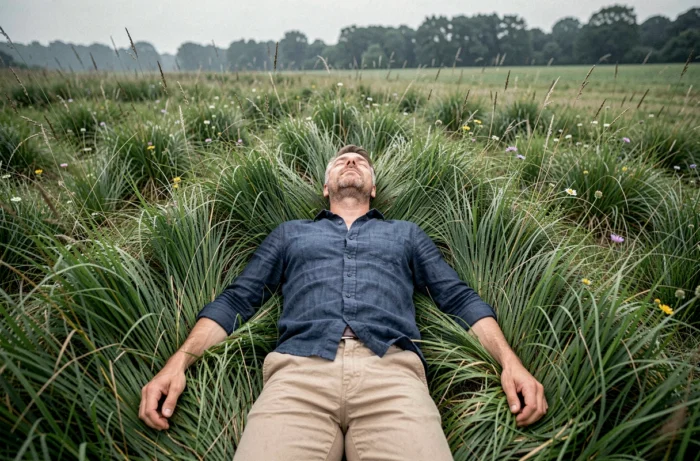
Progressive muscle relaxation involves voluntarily contracting a muscle group for a few seconds, then releasing it suddenly. We proceed zone by zone: feet, calves, thighs, abdomen, hands, forearms, shoulders, face. The contrast between contraction and relaxation teaches the body to identify tension and let it go.
In practice, you lie down or sit comfortably, eyes closed. A complete session lasts about fifteen minutes. Feedback varies on this point: some people feel relief from the first session, while others need two to three weeks of daily practice before noticing a clear difference.
Priority areas to target when time is short
If you only have a few minutes, three areas hold the majority of stress-related tension:
- The trapezius and neck, especially in people who work on screens. We raise our shoulders to our ears, hold, then release.
- The jaw. Clenching teeth (bruxism) is an extremely common stress reflex. We contract the jaw voluntarily, then open the mouth while letting the chin drop.
- The hands and forearms. We clench our fists tightly, hold, then spread our fingers wide. The relaxation often travels up to the shoulders.
Mindfulness meditation and stress: what clinical data says
Meditation is everywhere, from consumer apps to hospital programs. Not all relaxation techniques have the same level of scientific evidence. Mindfulness meditation is among the best-documented approaches.
According to the guide for prescribing non-drug interventions based on HAS, INSERM recommendations, and Cochrane reviews, mindfulness has a “moderate” level of evidence for stress management and mental health, particularly in oncology patients. This classification is based on controlled trials and cohort studies.
In practice, the technique involves focusing attention on the present moment, without trying to change what you observe. You concentrate on your breathing, bodily sensations, and surrounding sounds. When the mind wanders into rumination, you bring it back, without judgment.
Is meditating a few minutes a day enough to reduce stress?
This question often arises. Short sessions, repeated daily, produce measurable effects on perceived stress. The key point is not the duration of each session, but the regularity of practice over several weeks.
To start, you can use guided audio recordings of a few minutes. You sit, close your eyes, and follow the instructions. No need for a meditation cushion, a quiet room, or a specific posture. The living room, a bench in a park, or even public transport can work.
Physical exercise and nature: underestimated stress relievers in daily routines
We rarely think of brisk walking or gardening as relaxation techniques. Their effect on stress reduction is well established. Moderate physical activity lowers cortisol levels and promotes endorphin production.
The combination of exercise and contact with nature amplifies the benefit. Walking in a green space, even urban, has a more pronounced effect on blood pressure and anxiety levels than equivalent exercise indoors.
Additionally, HAS now promotes psychosocial approaches (social interaction, art therapy, leisure activities) as non-drug alternatives to reduce anxiety in vulnerable populations. This shift in framework is significant: relaxation and physical activity are no longer just wellness advice, but are included in institutional recommendations to limit the prescription of psychotropic drugs.
- Daily brisk walking, even for twenty minutes, in a park or wooded area.
- Repetitive manual activities (gardening, DIY, cooking) that focus attention and divert from rumination.
- Exposure to natural light in the morning, which regulates the sleep-wake cycle and alleviates chronic stress.
Daily stress does not disappear with a single technique applied once. What changes the game is identifying the method that truly fits into your day, then maintaining it. A short and regular practice beats a long occasional session. The rest is a matter of gradual adjustment.


