
An operation that remains stuck at the “upcoming” status in the La Banque Postale customer area generates uncertainty, especially when the amount is committed and the available balance does not reflect reality. Understanding why a transaction stagnates at this stage, and what causes the most frequent blockages, allows one to act before the situation complicates.
Name/IBAN verification: the rejection cause that clients discover too late
Since the implementation of the European regulation on instant SEPA transfers, banks in the eurozone must check that the beneficiary’s name matches the account holder linked to the IBAN. This verification, called “Verification of Payee,” is gradually being applied to all institutions, including La Banque Postale.
Specifically, if you enter “Jean Dupont” while the account is registered under “Jean-Pierre Dupont,” the bank may block or reject the transfer. The operation then remains in “upcoming” status without immediate explanation in the customer area. The client waits, follows up, and sometimes loses several business days.
To prepare for this, it is useful to avoid mistakes with La Banque Postale by systematically checking the exact name of the account holder before validating a transfer order. A recent bank account statement from the beneficiary, rather than a simple handwritten copy, remains the most reliable method.
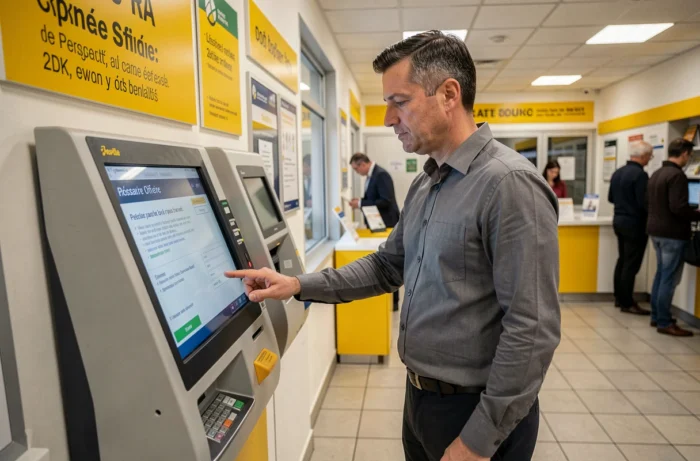
Processing times for La Banque Postale transfers: comparative table by type of operation
Not all transfers follow the same circuit. The processing time varies according to the nature of the operation, the time of issuance, and the day of the week. The table below summarizes the observable differences.
| Type of transfer | Usual delay | Frequent blockage factor |
|---|---|---|
| Internal transfer (between La Banque Postale accounts) | Almost immediate | Daily limit reached |
| Standard SEPA transfer | One business day | Order placed after the processing deadline |
| Instant SEPA transfer | Several seconds | Non-eligible IBAN or name/IBAN mismatch |
| International transfer (outside SEPA) | Several business days | Compliance check, currency, recipient country |
A validated standard SEPA transfer made on a Friday after the cut-off time will only be processed the following Monday. The operation displays “upcoming” throughout the weekend, which does not necessarily indicate an error.
Cut-off time and business days: the invisible gap
An order placed after the processing time is postponed to the next business day. This time varies according to the channels (mobile app, website, post office), and it is not always displayed visibly during validation.
Holidays and weekends are not bank business days. A transfer initiated on Ascension Thursday will be processed at the earliest on Friday, or even Monday if the bridge is observed by the interbank clearing system.
IBAN and amount entry errors: the two most common technical causes
The majority of operations stuck at “upcoming” status are due to human errors during entry. Two cases consistently recur.
- Incomplete or incorrectly copied IBAN: a digit inversion, a missing character, or an incorrect country code is enough to cause a rejection. The control key integrated into the IBAN detects some errors, but not all inversions
- Amount exceeding the authorized limit: each type of card and account has a daily or monthly transfer limit. An excess blocks the operation without clear notification in some cases
- Beneficiary not registered or pending validation: adding a new beneficiary in the customer area may require a security delay before the first transfer is authorized
In each of these cases, the operation appears as “upcoming” while it is actually suspended. The distinction between an operation under normal processing and a blocked operation is not always explicit on the interface.

Instant SEPA transfer: what the European regulation changes
Since January 9, 2025, all banks in the eurozone must be able to receive instant transfers in real-time. The next step, scheduled for October 9, 2025, mandates the sending of instant transfers without additional fees compared to standard transfers.
This evolution changes the interpretation of the “operation upcoming” status. When an instant transfer remains stuck at this stage for more than a few minutes, it constitutes a clearer signal of anomaly than before. Possible causes: enhanced security checks, a technical incident on the platform, or a mismatch during beneficiary verification.
What to do when an operation remains blocked
If the operation has displayed “upcoming” for more than one business day for a standard SEPA transfer, or more than a few minutes for an instant transfer, three actions can help unblock the situation:
- Check the IBAN and the beneficiary’s name in the order history, comparing them to the original bank account statement
- Consult the transfer limits in the account settings, and adjust them if the operation exceeds the configured limit
- Contact customer service via the secure area or by phone to obtain the exact reason for the blockage, as the “upcoming” status does not distinguish between normal processing and a pending rejection
A formal complaint can be filed if the blockage persists without explanation. La Banque Postale has a complaint service accessible from the customer area, with a defined response time.
The generalization of instant transfers mechanically reduces the window during which an operation can legitimately remain “upcoming.” Any prolonged stagnation now deserves active verification rather than simple waiting.


