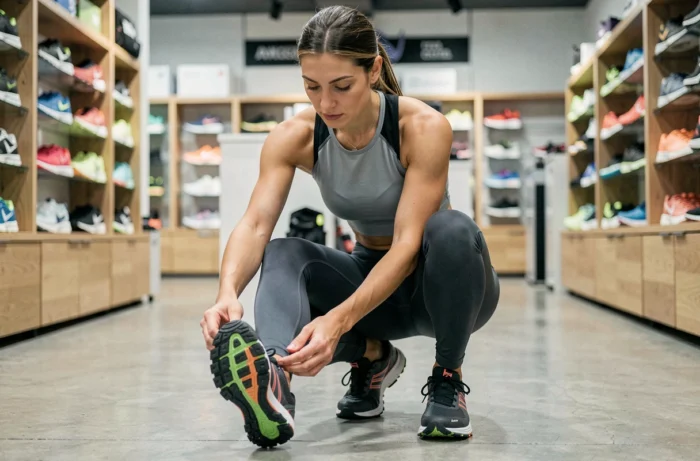
A sports equipment is defined by its ability to reduce mechanical stress on the body while maintaining or even improving the efficiency of the technical gesture. Choosing sports equipment to optimize performance requires understanding how each piece interacts with the biomechanics specific to a discipline. Perceived comfort is not enough: it is the match between the equipment, the physical profile, and the type of effort that determines the actual gain.
Running economy and carbon-plated shoes: a case study in sports equipment
Most buying guides treat shoes as a matter of comfort or foot support. The biomechanical angle is rarely addressed, even though it is the most documented lever in terms of performance.
Recent meta-analyses, particularly the synthesis by Rodrigo-Carranza et al. shared by Omni-Athlete, show that the combination of a thick, resilient midsole with a curved carbon plate significantly improves running economy compared to traditional competition shoes. The gains are more pronounced at high speeds.
Specifically, running economy refers to the amount of oxygen consumed to maintain a given pace. Reducing this expenditure, even modestly, helps delay fatigue during prolonged efforts. It is one of the few cases where a change in equipment produces a measurable and reproducible effect in endurance.
For a regular runner looking to improve in half-marathon or marathon, investing in a pair that incorporates this technology represents a concrete lever. For occasional outings at a moderate pace, the benefit remains marginal: the carbon plate expresses its potential mainly at high cadences. Consulting sports equipment on Quel Coach allows for better targeting of the gear suited to one’s level and goals.

Choosing your running, cycling, or fitness equipment: the weight of context
A literature review published in 2026 on trail and hiking shoes highlights a point often overlooked: the effect of equipment varies greatly depending on the terrain, the athlete’s profile, and weather conditions. A shoe that performs well on asphalt can become a hindrance on a technical and wet trail.
This observation extends well beyond shoes. In cycling, the rigidity of the frame, geometry, and wheel weight have different impacts depending on whether one is riding on flat roads or in the mountains. In fitness, a mat that is too soft absorbs energy from explosive movements, while a mat that is too hard weakens the joints during floor exercises.
Three variables to consider before any purchase
- The type of surface or environment: road, trail, gym, synthetic field. The sole, cushioning, and grip must correspond to the surface being used, not to a generic use.
- The frequency and intensity of sessions: a practitioner who runs three times a week uses their equipment differently than a Sunday jogger. Durability and support become priorities after a certain volume.
- Body shape and injury history: marked pronation, a fragile knee, or a sensitive back guide the choice toward specific characteristics (drop, width, foam density).
Buying the most expensive or the newest model without considering these three parameters is akin to choosing randomly.
Safety and standards: what equipment must guarantee before performance
Optimizing performance also involves the ability to train without interruption. An injury related to faulty or unsuitable equipment can cost weeks of progress. Safety is not a bonus: it is the foundation upon which any performance approach rests.
The European regulation on personal protective equipment (EU 2016/425) governs the design and marketing of sports protections (helmets, knee pads, shin guards). This text imposes requirements for shock resistance, ergonomics, and CE marking. An equipment without CE marking offers no guarantee of standardized protection.
For high-risk sports (cycling, skiing, combat sports), checking compliance with harmonized European standards is not a common reflex among amateur practitioners. Yet, it is the first filter to apply before comparing prices or features.

Maintenance and lifespan: when to replace your sports equipment
Equipment loses its mechanical properties long before showing visible signs of wear. The cushioning foam in a running shoe gradually compresses, reducing its ability to absorb shocks. A bicycle helmet that has sustained an impact, even without visible cracks, no longer guarantees the same level of protection.
Concrete signs that a replacement is necessary
- The cushioning of the shoes seems significantly less responsive than when purchased, or joint pain appears without a change in training volume.
- The seams of a technical garment (sports bra, shorts) are stretched: support and compression no longer function properly.
- A helmet has sustained a direct impact, even at low speed: the internal expanded polystyrene structure does not regenerate.
- The spikes on a trail shoe feel smooth to the touch: grip on wet terrain becomes insufficient.
Extending the lifespan of equipment requires regular maintenance: rinsing after each outing for shoes, washing at low temperatures for technical textiles, and storing away from moisture and UV for helmets and protections.
The choice of suitable sports equipment is based on a simple logic: start from the constraints (terrain, body shape, intensity), check compliance with safety standards, and only then compare performance technologies. Well-maintained equipment that is replaced at the right time remains the best investment for progressing without injury.


