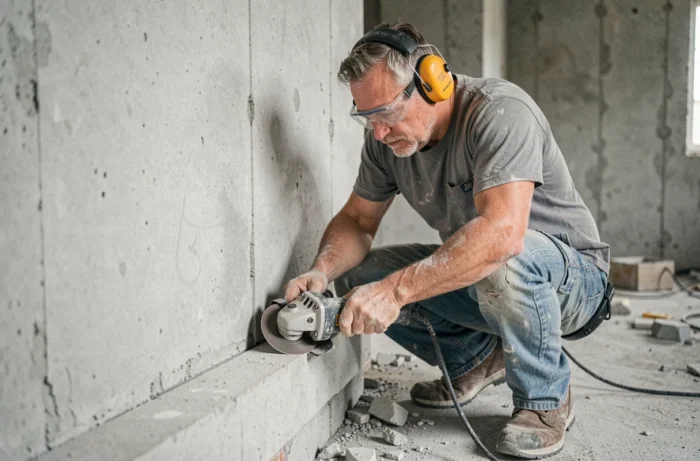
Cutting a concrete slab close to a wall presents a problem that general guides rarely address: the lateral clearance constraint. Most floor saws require several centimeters of clearance from a vertical obstacle, making the final cutting section inaccessible with the main tool. It is in this dead zone, between the blade and the wall, that the risks of cracks, chips, and structural damage are concentrated.
Lateral clearance by tool: comparison of minimum distances to the wall
The choice of tool directly determines the residual distance between the cut line and the wall. This parameter conditions the entire intervention strategy.
| Tool | Minimum distance to the wall | Indicative cutting depth | Dust projection |
|---|---|---|---|
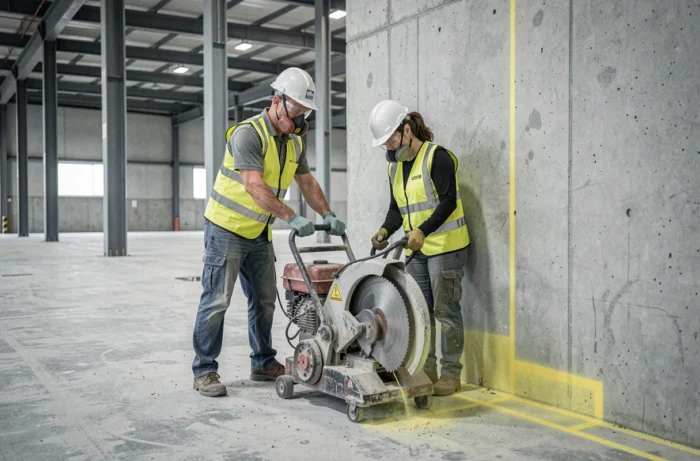
| Gas-powered floor saw (350 mm) | Several centimeters (wide guard) | High | Very high when dry |
| Angle grinder (230 mm) | Reduced (a few centimeters) | Medium | High when dry |
| Wall saw on rail | Almost none (flush cut) | High | Low (water cut) |
| Expansive mortar (type Dynacem) | None (drilled holes) | Any thickness | None |
The floor saw, the most common tool for slabs, is paradoxically the least suitable for cuts near a wall. Its protective guard requires a setback that systematically leaves an uncut strip against the wall.
The angle grinder reduces this distance, but its cutting depth remains limited. On a reinforced slab, it is often necessary to make the cut in several passes, which increases the risk of deviation from the cut line.
When it comes to cutting a concrete slab near a wall without any residual gap, the wall saw on rail and the expansive mortar are the two techniques that allow for a flush intervention. Their costs and implementation differ, but they eliminate the lateral clearance problem.
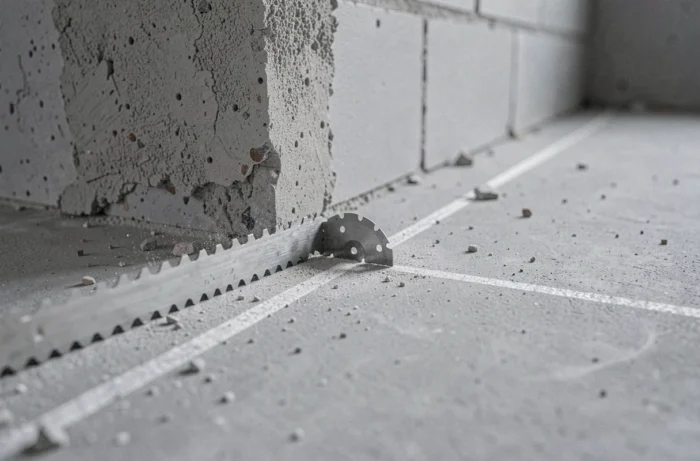
Support area of the slab on the wall: what the cut modifies in the structure
A reinforced concrete slab rests on its peripheral supports, often the walls themselves. Notching the slab close to a load-bearing wall means reducing or even eliminating the load transfer area between the slab and its support.
A notched slab near its support loses its ability to transfer loads to the wall. The design rules for reinforced concrete specify minimum anchorage lengths for the rebar. Cutting in this area potentially severs the reinforcements at the worst point.
Before any intervention, it is essential to determine whether the wall in question is load-bearing or not. A load-bearing wall made of standard concrete blocks and a concrete partition wall do not react the same way to a modification of the support of the upper slab.
Locating the reinforcements before cutting
A metal detector or a pachometer can locate the welded mesh and the main rebar. The standard mesh has a regular grid, but reinforcements (caps, edge rebar) are often concentrated precisely in the support area, against the wall.
- Identify the position and direction of the main rebar before marking the cut line, to avoid severing a structural reinforcement
- Check for the possible presence of electrical conduits or pipes embedded in the slab, particularly in the first few centimeters along the wall
- Verify the actual thickness of the slab at the cut point (a spot check or partial coring is sufficient), as an added screed can distort visual estimation
The edge rebar is the most critical to preserve. Its section ensures resistance to negative moments at the support. Cutting it poses a risk of progressive cracking that may only manifest several months after the intervention.
Silica dust in confined spaces: the underestimated risk near a wall
Cutting concrete generates respirable crystalline silica dust, classified as a known carcinogen. Near a wall, natural ventilation is reduced: the vertical obstacle creates a stagnation zone where the concentration of fine particles increases rapidly.
A FFP1 mask is no longer considered sufficient for concrete cutting. Recent safety guidelines recommend at least an FFP2 respirator, and for long cuts or indoor work, a half-mask with P100 filters.
Water cutting significantly reduces dust emissions, but it is not always feasible indoors (runoff, electrical risk). On the other hand, integrated dust extraction systems on the grinder offer an acceptable compromise for short cuts, provided the suction flow and filter class are checked.
Expansive mortar technique: vibration-free cutting against a wall
Expansive mortar (sometimes called demolition cement) represents a relevant alternative when the proximity of the wall prohibits any mechanical cutting tool or when vibrations are a risk factor.
Principle and implementation
The process involves drilling a line of holes in the slab, parallel to the wall, and then pouring in the expansive mortar. As it rehydrates, the product exerts internal pressure that cracks the concrete along the line of least resistance, that is, between the holes.
- Diameter of holes and spacing adapted to the thickness of the slab (the manufacturer’s technical sheets specify these parameters for each configuration)
- The reaction time varies according to ambient temperature: in cold weather, the setting is significantly slower
- No vibrations transmitted to the adjacent wall, preserving joints, coatings, and fragile elements (tiles, embedded pipes)
- The resulting cut is less clean than a diamond saw cut, but a finishing pass with the grinder over a few millimeters is sufficient to smooth the edge
Expansive mortar eliminates vibrations and silica dust, two major constraints of mechanical cutting in confined areas. Its main drawback remains the delay: it generally takes several hours before the pieces can be removed.
Post-intervention cracks: monitoring over time
After any slab cutting near a wall, microcracks may appear in the following weeks, especially if the support has been partially modified. A simple patch does not address the cause of a crack related to load imbalance. Diagnostic professionals recommend photographic monitoring and regular measurements to distinguish a stable crack from an evolving one.
Cutting a concrete slab against a wall is not just a matter of tools. The geometry of the support, the type of edge reinforcements, and dust management determine success as much as the choice between saw, grinder, or expansive mortar. On a load-bearing wall, a prior structural assessment remains the most cost-effective precaution, far outweighing the cost of the tool.


