
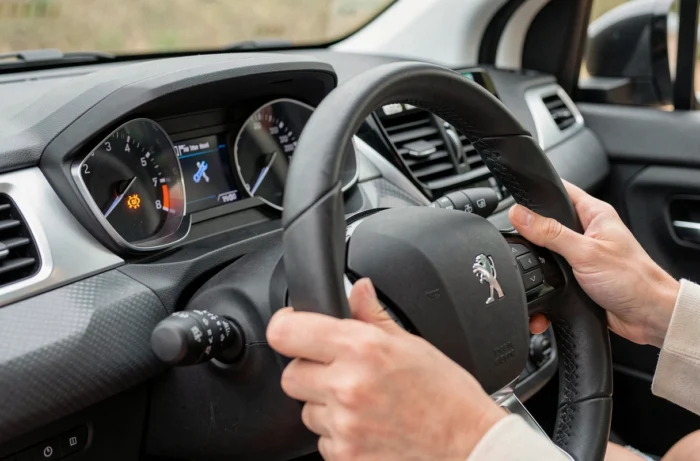
The wrench-shaped warning light on the dashboard of a Peugeot 208 often causes confusion. This orange indicator does not signal an engine failure, but a scheduled reminder from the vehicle’s computer. Its persistence after an oil change or maintenance performed outside the Peugeot network leads many drivers to seek the correct procedure to turn it off.
On recent models, the situation becomes more complicated: Peugeot uses two distinct wrench-shaped indicators, and the reset procedure only works for one of them.
Maintenance Key and SERVICE Key on Peugeot 208: two indicators, two logics
Before any manipulation, it is essential to identify which indicator is actually displayed. On recent Peugeot 208 models, the manufacturer distinguishes between the maintenance key (periodic service reminder) and the SERVICE key, which encompasses one or more minor anomalies without a specific dedicated indicator.
The maintenance key lights up based on the mileage traveled or the time elapsed since the last service. The computer automatically triggers this reminder, and resetting it via the dashboard is enough to turn it off once the maintenance is completed.
The SERVICE key works differently. It indicates a minor fault recorded by the system (faulty sensor, low fluid level, secondary electronic anomaly). In this case, resetting the counter will not turn off the indicator as long as the fault remains active. The actual cause is displayed in the text message on the instrument cluster, not in the icon itself.
This distinction, documented in the recent Peugeot range, explains why some drivers follow a reset tutorial without success. Knowing how to remove the wrench indicator on Peugeot 208 first requires checking which indicator is concerned.
Reset Procedure for the Maintenance Indicator on Peugeot 208
If the indicator corresponds to the maintenance key (service reminder), the manipulation is performed directly from the driver’s seat, without diagnostic tools. The procedure varies slightly between the first generation 208 and the 208 II, but the principle remains the same.
Steps to Reset on 208 Petrol and Diesel
- Turn off the ignition, then press and hold the trip reset button.
- Without releasing the button, turn the ignition back on (ON position, without starting the engine). Keep holding for about ten seconds.
- The maintenance counter will display a countdown or return to the maximum value of kilometers before the next service. Release the button once the reset is confirmed on the screen.
On some models equipped with a digital screen, navigation is done via the steering wheel controls. You need to access the “Maintenance” menu in the settings of the cluster, then confirm the reset.
A detail often overlooked in video tutorials: the ignition must be completely off before the manipulation. Simply switching to accessory mode (without turning off and then on) prevents the procedure from working on several versions of the PSA computer.
Persistent Wrench Indicator: Common Causes Outside of Oil Change Deadline
When the reset is performed correctly but the indicator remains lit, the problem lies elsewhere. Several situations can cause this indicator to persist on a Peugeot 208.
The most common case involves a minor fault recorded in the computer. A slightly out-of-tolerance boost pressure sensor, low AdBlue level on diesel versions, or a temporary anomaly in the pollution control system can trigger the SERVICE key without lighting the engine warning light (MIL).
The second case involves an error during the procedure itself. On the 208 II, the physical manipulation with the trip button does not always work. Some versions require going through the digital menu of the cluster. Feedback from the field varies on this point depending on the model year and software updates of the vehicle.
When an OBD Diagnostic Tool Becomes Necessary
If the indicator persists after a correct reset and an anomaly message appears, reading the fault codes via an OBD port is the only reliable method to identify the cause. Compatible PSA diagnostic tools (or public OBD interfaces with suitable software) allow reading stored codes and, if necessary, erasing them.
Clearing a fault code without correcting the cause does not solve anything: the computer will detect the anomaly again and turn the indicator back on during the next driving cycle. This approach only serves to confirm whether the fault is active or historical.

Peugeot 208: Maintenance Deadlines and Computer Logic
The triggering of the wrench indicator on recent PSA models does not rely solely on mileage. The computer also takes into account the time elapsed since the last reset. A vehicle that is not driven much may see its indicator light up after several months, even without reaching the mileage deadline.
This dual logic (distance and time) explains why drivers who drive little are surprised by the appearance of the indicator. The computer considers that oil and filters degrade over time, regardless of the actual use of the vehicle.
For owners who perform maintenance themselves, resetting after each intervention is a step not to be overlooked. Without this manipulation, the system continues its countdown based on the old cycle, and the indicator reappears at a deadline shifted from the maintenance actually performed.
One last point to keep in mind: on a used Peugeot 208, the wrench indicator lit at purchase may mask neglected maintenance or simply a reset forgotten by the previous owner. Having the fault codes read before limiting yourself to a reset remains the safest approach to start on a reliable basis.


