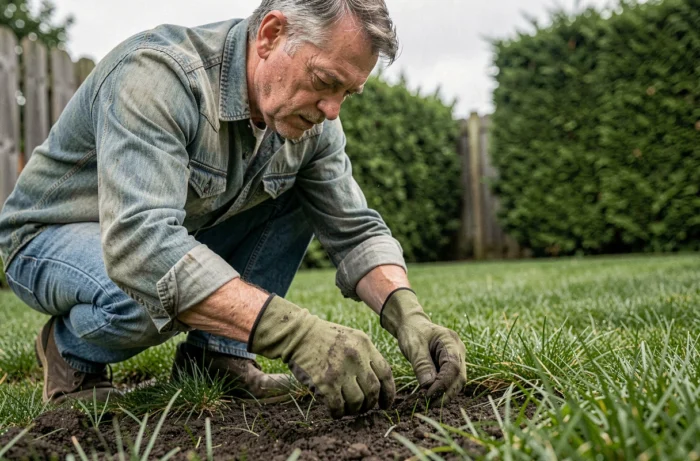
A lawn that remains green and dense relies less on the frequency of interventions than on their relevance. Each maintenance action affects a specific parameter of the soil or plant: root structure, nitrogen availability, water retention capacity. Understanding these mechanisms allows for adapting one’s strategy to the terrain rather than following a generic calendar.
Regulations on lawn herbicides: what changes for individuals
Since the Labbé law and its successive reinforcements, synthetic selective herbicides are prohibited for individuals in France. Classic molecules such as MCPA, dicamba, or glyphosate can no longer be sold, used, or even possessed for domestic use. The penalties are severe, potentially reaching six months in prison and a fine of 150,000 euros.
Only biocontrol products and those labeled EAJ (Authorized for Use in Gardens) remain legal. In practice, this means that the fight against weeds now relies on mechanical and cultural means: densification of the lawn, appropriate mowing height, and regular reseeding of sparse areas.
This regulatory constraint profoundly changes the approach to lawn care. Rather than addressing a problem with clover or dandelions after the fact, everything hinges on prevention. A sufficiently dense and well-nourished lawn leaves little room for weeds, which mainly colonize bare or weakened areas. To delve deeper into this preventive logic, Clic Garden’s lawn advice details the varieties and practices suited to each situation.
Soil structure and rooting: the foundation of a resilient lawn
Before discussing mowing or watering, the soil deserves full attention. A lawn installed on compacted soil develops shallow roots, making it vulnerable to drought and trampling. Mechanical aeration of the soil conditions the depth of rooting, and thus the overall resilience of the lawn.
Aeration involves perforating the soil several centimeters deep using a blade or coring aerator. This operation, ideally performed in the fall, loosens the soil, improves air circulation, and facilitates water infiltration to the deep roots. On clayey soils, it makes a visible difference by the following spring.
Scarification complements this work by removing thatch, the layer of dead plant debris that accumulates between the grass blades and the soil. This thatch prevents water and nutrients from reaching the roots. Scarifying once or twice a year (in spring and fall) keeps the soil receptive.
Indicators of compacted soil
- Water stagnates on the surface after moderate rain instead of infiltrating within minutes
- The lawn yellows in patches despite regular watering, a sign that the roots can no longer access moisture at depth
- A screwdriver pushed by hand penetrates hardly beyond a few centimeters
Nitrogen fertilization and seasonal lawn calendar
Nitrogen is the engine of leaf growth. A lawn lacking nitrogen loses its color, becomes sparse, and becomes permeable to weeds. However, an excess of nitrogen at the wrong time produces soft growth, susceptible to fungal diseases.
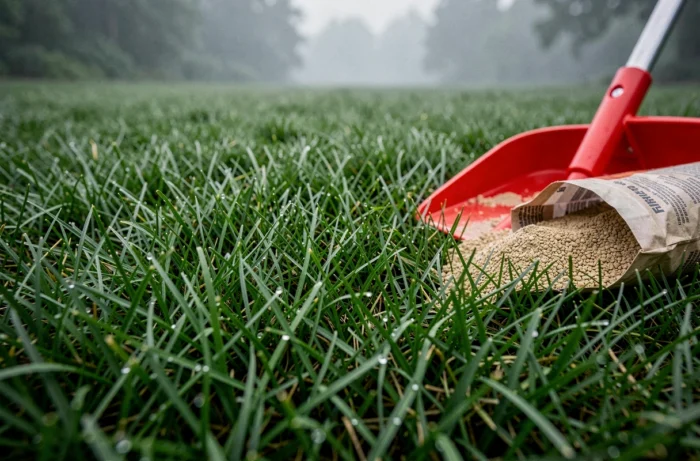
A slow-release fertilizer applied in spring and fall covers the two active growth periods of grasses. In spring, the application stimulates tillering (the multiplication of blades from the same plant). In fall, it strengthens root reserves before winter.
In summer, however, it is better to suspend all nitrogen fertilization. Heat and lack of water put the lawn into partial dormancy. Forcing growth at this time weakens the plant and accelerates yellowing.
NPK ratio suitable for lawns
Lawn fertilizers display a nitrogen-phosphorus-potassium (NPK) ratio where nitrogen predominates. Potassium, the second key element, enhances resistance to water stress and temperature variations. Phosphorus, on the other hand, plays a crucial role during establishment or reseeding, when young roots need to develop quickly.
Watering during drought: frequency versus depth
Watering little but often is the most common mistake. Frequent and light applications maintain moisture only on the surface, encouraging roots to remain shallow. A generous and spaced watering encourages roots to seek water at depth, making the lawn naturally more resistant to drought.
In practice, abundant watering every four to five days during dry periods is preferable to daily watering. The soil should be moistened to a significant depth. The best time remains early morning, when evaporation is minimal and the foliage has time to dry before nightfall, limiting the risk of fungal diseases.
Prolonged drought episodes, increasingly frequent in France in recent years, cause yellowing that often raises unnecessary concern. Most lawn grasses enter dormancy when water is scarce: the leaves turn brown, but the roots remain alive. The lawn naturally greens up again with the return of rain, provided it has not been mowed too short during the stress period.
Mowing height and mulching: two often underestimated levers
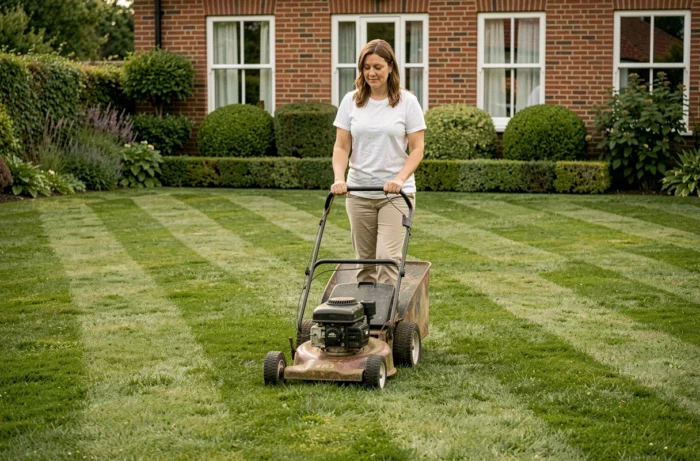
The cutting height directly affects photosynthesis and soil protection. A lawn mowed too short exposes the soil to sunlight, accelerates evaporation, and encourages the germination of weed seeds. Maintaining a higher cutting height in summer (around seven to eight centimeters) protects the soil and limits thermal stress.
The one-third rule applies to each mowing: never cut more than one-third of the total height of the blade. Cutting more causes physiological shock that slows regrowth and weakens the plant.
- Mulching, which involves leaving finely shredded mowing residues in place, returns nitrogen and organic matter to the soil with each pass
- Well-sharpened mower blades make a clean cut that heals quickly, whereas a dull blade tears the blade and opens the door to diseases
- In autumn, collecting fallen leaves prevents them from forming a damp mat conducive to moss and fungi
Reseeding bare areas, done in September or April, complements these practices. Sowing a mix suited to the terrain’s use (trampling, shade, dry soil) on bare patches helps maintain sufficient density for the lawn to act as its own barrier against weeds.
A resilient lawn is built over several seasons. The results are not immediate, but each targeted intervention, from autumn coring to high mowing in summer, adds up to create a lawn capable of enduring dry summers without chemical intervention.


