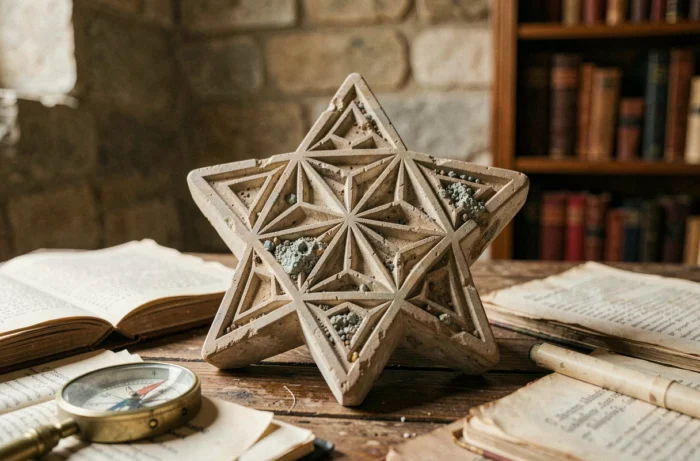
The heptagram is not constructed like a pentagram. While the five-pointed star is drawn in one continuous line by connecting each vertex to the second following one, the seven-pointed star allows for two distinct polygonal paths: the {7/2}, which connects each vertex to the second following one, and the {7/3}, which skips two vertices at each step.
These two figures produce visually different stars, the second being more compact and sharper. This geometric property, linked to the fact that 7 is a prime number, partly explains why the heptagram holds a unique place in sacred geometry: it resists subdivision into symmetrical sub-figures, unlike the hexagram (two triangles) or the octagram (two squares).
Geometry of the Heptagram: Why the Number 7 Resists Classical Construction
A rarely discussed point in popular articles: the regular heptagon is impossible to construct with a ruler and compass. Carl Friedrich Gauss demonstrated that only polygons whose number of sides is a product of powers of 2 and distinct Fermat primes are constructible. Since the number 7 is not a Fermat number, the heptagram remains an approximate figure in any manual realization.
This impossibility has fueled the symbolic charge of the motif. When a geometric drawing escapes the fundamental tools of the ancient geometer, it acquires a status of exception. We observe that this particularity has led several traditions to associate the heptagram with what transcends ordinary reason, with reserved knowledge or a reality inaccessible by common means.
Exploring the meaning of the seven-pointed star, we find this thread connecting mathematical impossibility and spiritual dimension. The symbol draws its strength from this tension between formal rigor and technical limit.

Seven-Pointed Star and Planetary Correspondences: A System Preceding the Zodiac
The link between the heptagram and the seven visible planets of antiquity (Sun, Moon, Mercury, Venus, Mars, Jupiter, Saturn) structures the use of the symbol long before its appropriation by modern esoteric currents. Each branch of the star is assigned a celestial body, and the order in which one traverses the vertices of the {7/2} produces the sequence of the days of the week.
This is not a folkloric coincidence. The order of the days exactly follows the geometric path of the heptagram {7/2}, starting from Saturn (Saturday) and skipping one vertex at each step. This system, attested in late Roman tradition, predates the codification of the zodiac into twelve signs and reflects a cosmology where 7 organized time before 12 structured celestial space.
Distinction Between Cosmological Use and Talismanic Use
The planetary attribution falls within a descriptive cosmological model. The talismanic use, on the other hand, mobilizes the heptagram as a seal of protection or invocation. The confusion between these two registers weakens most contemporary analyses. An heptagram engraved on a medieval talisman does not serve the same function as an astronomical diagram: the former aims for an action on reality, while the latter represents an ordered depiction of the cosmos.
Heptagram in Christian Tradition: The Seven Gifts and Genesis
In medieval Christian iconography, the seven-pointed star refers to the seven gifts of the Holy Spirit (wisdom, understanding, counsel, strength, knowledge, piety, fear of God) as enumerated in the Book of Isaiah. It appears on rose windows, illuminations, and ecclesiastical seals, often associated with the dove.
The number 7 in Genesis structures the narrative of Creation in seven days, linking the heptagram to the idea of a complete cycle, a finished totality. Unlike the pentagram, which has oscillated between Christic symbol (the five wounds) and diabolical mark depending on the era, the heptagram has never undergone a negative symbolic reversal in the Christian context.
Seshat and the Egyptian Tradition
The Egyptian goddess Seshat, patroness of writing and archives, bears a motif identified as a seven-pointed star on her headdress. Seshat embodies hidden knowledge and the measurement of sacred time. Her association with the heptagram suggests that the symbol already functioned as a marker of knowledge reserved for scribes and priests, long before Hellenistic syncretisms.
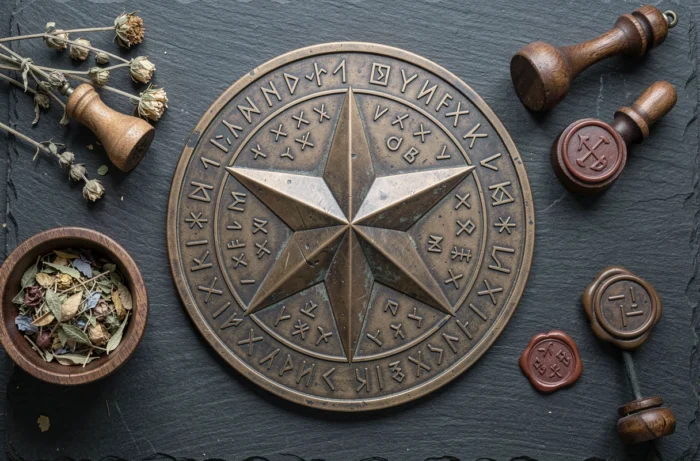
Contemporary Appropriation of the Seven-Pointed Star: From Sacred to Commercial
In recent years, the heptagram has migrated to unexpected registers. In the online jewelry and textile sector, the expression “7 Star Silver” now designates 925 silver jewelry adorned with a seven-pointed star, positioned as “premium” pieces in B2B catalogs. The symbol functions there as a marker of commercial status rather than as a mystical sign.
The same shift is found in certain structures of relational marketing, where the “7 Star” tier identifies a high level of performance, with the heptagram as a visual icon of hierarchical progression. This transfer from the sacred to the corporate deserves attention: it shows that the symbolic charge of 7 remains powerful enough to structure modern motivation systems.
- In B2B jewelry, the heptagram signals a high-end positioning on sourcing platforms, with a shift from the symbolic to luxury marketing.
- In corporate compensation plans, the “7 Star” label visually associates the seven-pointed star with a high-performance tier, diverting the symbol from its esoteric register.
- In graphic design and branding, the seven-pointed motif serves as a distinctive logo when five- or six-pointed stars are deemed too common.
Differentiating the Heptagram from the Pentagram and Hexagram
The confusion between these figures is common. The pentagram (five points) is associated with natural elements and Pythagorean tradition. The hexagram (six points), or Star of David, falls within a symbolism of union of opposites (fire and water, masculine and feminine). The heptagram, however, does not allow decomposition into elementary sub-figures, placing it in a register of irreducibility.
This geometric irreducibility directly nourishes its symbolic charge: where 5 and 6 can be decomposed and interpreted through binary opposition, 7 remains whole, indivisible, referring to a completeness that does not fragment. It is precisely this property that explains its persistence in contexts as varied as Christian liturgy, ancient astrology, and contemporary branding.
The heptagram traverses the ages without ever losing its fundamental strangeness. Its resistance to exact construction, its organic link to the weekly cycle, and its geometric irreducibility make it a symbol that functions both by what it refuses and by what it represents.


