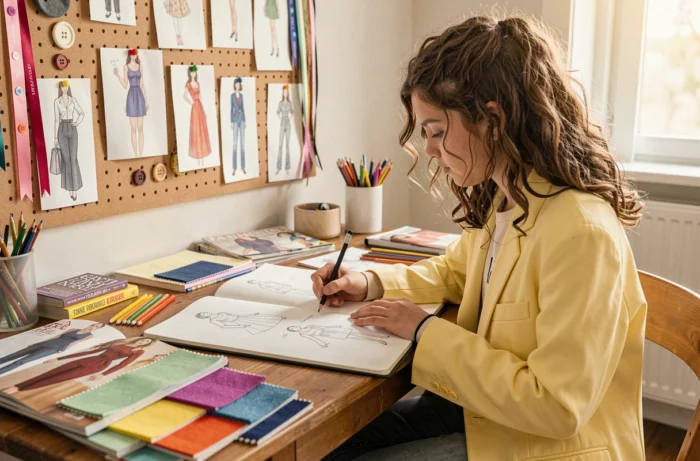
Drawing silhouettes in a notebook, assembling fabric scraps, posting the results on social media: the process seems simple. But between a creative hobby and an activity that resembles the profession of a stylist, the legal, technical, and educational boundaries are clearer than one might think, especially when the creator is 12 years old.
Legal Framework for a Young Minor Fashion Creator in France
The first question to ask is not “how to draw a dress,” but “what does the law say when a child monetizes their creations.” The answer is contained in one text: the law n° 2020-1266 of October 19, 2020, supplemented by the decree of April 28, 2022.
This provision, often referred to as the “influencer children” law, equates the regular and monetized dissemination of content by a minor under 16 years old to child performance work. If a 12-year-old uses TikTok, Instagram, or YouTube to showcase and sell their fashion creations, the following obligations apply:
- Parents must obtain a prefectural approval before any regular dissemination of monetized content (product placements, partnerships, sales related to online visibility).
- A portion of the generated income must be blocked at the Caisse des dépôts et consignations until the child reaches adulthood or is emancipated.
- Failure to comply with these rules exposes one to criminal penalties of up to five years in prison and a fine of 75,000 euros for unauthorized work.
This framework does not concern the sketchbook stored in a drawer. It comes into effect as soon as there is regular public dissemination with financial compensation. For a teenager who wants to become a stylist at 12 years old, the distinction between shared passion online and regulated commercial activity should be established from the outset with parents.
Stylist Skills to Develop Before and After Age 14
The skills utilized by a professional stylist are not all accessible at the same age. The table below distinguishes what a young creator can work on alone or with light support, and what requires structured learning accessible later.
| Skill | Accessible from age 12 | Requires a structured framework (after 14-15 years) |
|---|---|---|
| Fashion drawing (sketches, silhouettes) | Yes, with books or tutorials | Technical drawing classes in art school |
| Inspiration research (moodboard) | Yes, collages, Pinterest, magazines | Professional trend analysis |
| Working with colors and materials | Yes, free experimentation | Colorimetry, knowledge of textiles |
| Sewing and assembly | Basics by hand or simple machine | Pattern making, modeling, flat cutting |
| Creating a mini-collection | Yes, a few coherent pieces | Building a complete collection with a collection plan |
| Online communication and sales | Under strict parental control (law 2020-1266) | Marketing, business management |
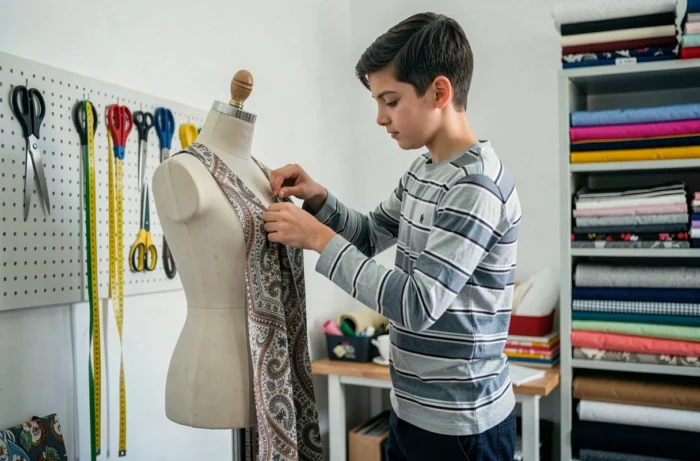
The main gap lies in the technical skills of modeling and pattern making, which require tools and supervision that are rarely available before high school. In contrast, fashion drawing, moodboarding, and simple garment assembly can be practiced from age 12 without formal training.
Fashion Internships for Teens: Prices, Duration, and Content Compared
Several organizations offer creative immersions for teenagers. La Couture Brigade in Paris organizes a “Fashion Camp” internship for ages 13-16, beginner level. The program covers inspiration research, moodboarding, working with colors and materials, fashion drawing, and creating a personal mini-collection. The advertised price is 480 euros for three days, materials included.
This type of internship allows one to test genuine interest in the profession before committing to a long course. For a 12-year-old, the minimum required age (13 years at La Couture Brigade) means waiting a few months, which provides time to solidify the basics in drawing and fashion culture.
What These Internships Do Not Replace
Three days of immersion provide a glimpse into the creative process of a stylist. They do not cover pattern making, production management, or marketing. A short internship reveals an appetite, it does not validate a career path.
Distance learning options also exist, such as the CNFDI course in children’s styling and modeling, which includes an articulated mannequin and offers in-person internships as an option. This format suits a school schedule but assumes a level of personal discipline that not all 12-year-olds have yet acquired.
Free Tools and Styling Books to Start at Age 12
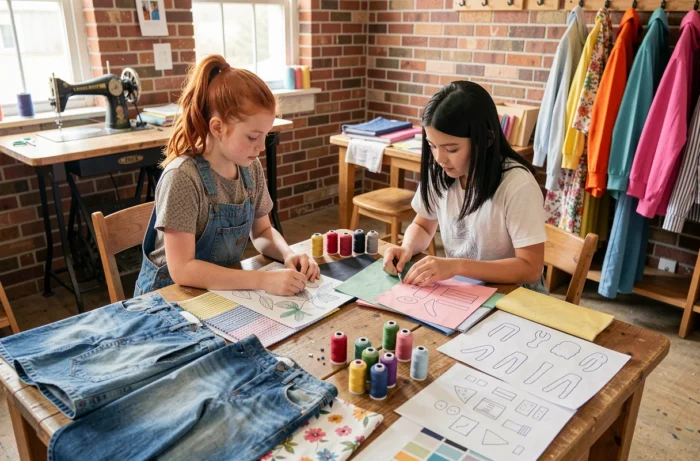
Before investing in an internship or training, several resources allow for structuring autonomous learning. Nathan Editions has published a collection dedicated to youth styling, illustrated by Pascale d’Andon and written by Catherine Pouligny, a fashion journalist. The book “Profession Stylist” details in eight chapters the facets of the profession: seeking inspiration, selecting fabrics, drawing silhouettes.
On the digital side, free graphic creation tools (Canva, CapCut for video editing of lookbooks) allow one to transition from paper sketches to polished visual presentations. The digital moodboard replaces the paper collage and facilitates sharing with peers or an art teacher.
- A dedicated sketchbook, used daily, builds a personal style faster than an occasional class.
- Collecting fabric samples (scraps from haberdashery, old clothes cut up) trains the eye and touch for materials.
- Reproducing existing garments by varying proportions develops an understanding of volumes.
School Orientation and Fashion Pathways After Middle School
The choice of orientation becomes concrete in the third year of middle school. Several pathways lead to the profession of stylist, but they are not all equal at the same stage.
A general baccalaureate with a specialization in visual arts opens access to higher fashion schools. A technological baccalaureate STD2A (sciences and technologies of design and applied arts) offers a more technical training starting in the second year. For profiles attracted to production, a CAP in fashion trades allows entry into apprenticeships from age 16.
The most common educational path to styling involves a baccalaureate followed by a BTS or a specialized school, often in Paris where the majority of recognized training programs are concentrated. At 12 years old, the priority remains to nurture creativity without closing any doors: drawing, sewing, observing, and above all, not confusing a momentary passion with a fixed professional project.


