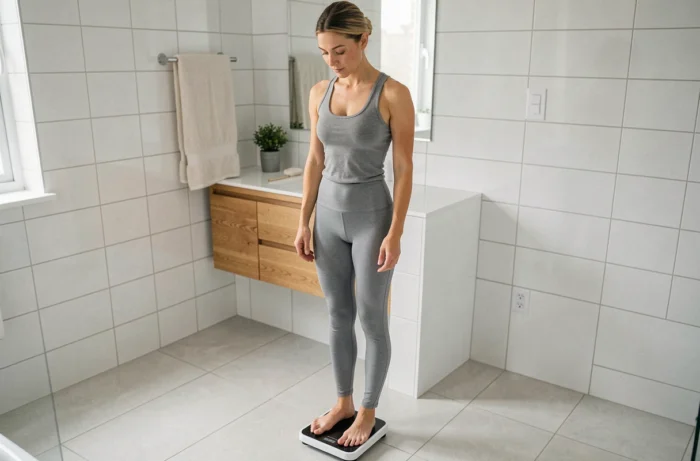
For a woman measuring 1.57m, the answer to the question of ideal weight does not lie in a single number. The body mass index sets a range, but this figure says nothing about fat distribution or the actual metabolic profile. Several complementary indicators allow for a more refined assessment, and their intersection can sometimes radically change the interpretation of a result deemed normal on paper.
Waist circumference and waist-to-height ratio: indicators that BMI does not replace
BMI remains the most widely used tool to situate a weight within a standardized reading grid. For a woman of 1.57m, the formula classifies as “normal” any weight within the range corresponding to a BMI between 18.5 and 25. In practice, this gives a fairly wide range, which can suit very different health profiles.
The problem is well-known: BMI does not distinguish between fat mass and muscle mass. Two women of the same height and weight can have opposing body compositions, with metabolic risks that are unrelated. This is where the waist-to-height ratio comes in, increasingly recommended as a complement.
The principle is simple: divide your waist circumference by your height in centimeters. A ratio below 0.5 corresponds to abdominal fat without increased risk. Between 0.5 and 0.59, the risk increases. From 0.6 onwards, it is considered high. For a woman of 1.57m, this concretely means aiming for a waist circumference of less than about 78.5 cm, measured at normal expiration, without sucking in the stomach.
This criterion does not replace BMI but usefully complements it. French recommendations relayed by Alptis indicate that HAS recommends supplementing the assessment with waist circumference when BMI is between 25 and 35. In women, a threshold of 80 cm is associated with increased metabolic risk.
To accurately estimate the ideal weight for a woman of 1.57m, it is therefore necessary to cross-reference at least BMI and waist circumference, rather than relying on a single marker.
Lorentz formula and Creff formula: what they really calculate
The most cited formulas for estimating a reference weight are those of Lorentz and Creff. They do not measure the same thing and do not target the same profiles.
The Lorentz formula uses only height and sex. It produces a single figure, without taking age or morphology into account. For women, it includes a correction coefficient related to sex, but the result remains an average estimate, originally designed for calculating medication dosages, not for setting an aesthetic goal.
The Creff formula adds two variables: age and morphology (slim, normal, or large). It therefore produces different results for the same height depending on the declared body frame type. This is an advantage on paper, but the limitation is obvious: self-assessment of morphology remains subjective and there is no standardized protocol for determining it oneself.
Both formulas provide benchmarks, not verdicts. The discrepancies between them can reach several kilograms for the same person, which clearly shows that neither holds the definitive answer.
- The Lorentz formula is suitable as a first quick estimate but ignores age and actual body composition.
- The Creff formula attempts to refine the result by incorporating morphology, at the cost of some approximation in categorization.
- Neither takes into account body composition (muscle/fat ratio), which remains their common blind spot.
Ideal weight at 1.57m according to age: why the range changes
An often overlooked element in online calculators is the influence of age on the interpretation of weight. The range considered healthy does not remain fixed over the decades.
Some public health recommendations use, for individuals aged 60 and over, a different BMI range than that applied to younger adults. The source cited in the literature mentions a range of 22 to 27, compared to 18.5 to 25 for the general adult population. The same weight is not interpreted in the same way at 30 years old and at 65 years old.
This nuance has practical consequences. A woman of 1.57m whose BMI hovers around 26 at 35 years old is classified as slightly overweight according to the standard grid. The same value at 65 years old could be considered quite appropriate, even protective against certain aging-related risks.
The trap would be to compare one’s current weight to a figure calculated without taking this variable into account. Online tools rarely provide this precision, which can generate disproportionate concern or, conversely, false reassurance.

When to consult a doctor to evaluate weight at 1.57m
The formulas and ratios provide useful benchmarks, but they do not replace an individualized assessment. Several situations justify consulting rather than multiplying online calculations.
- A waist circumference greater than 80 cm associated with a BMI between 25 and 35: HAS then recommends a complementary assessment of metabolic risk.
- Rapid and unexplained weight fluctuations, both up and down, which may signal a hormonal or nutritional imbalance.
- A family history of diabetes, cardiovascular diseases, or obesity, which alters the interpretation of standard thresholds.
- An intensive sports practice that skews BMI due to high muscle mass.
A doctor may use complementary measures (bioelectrical impedance analysis, lipid profile, blood glucose) to situate weight within a broader health context. The number on the scale is just a starting point, not a diagnosis.
For a woman of 1.57m, the healthy weight range therefore depends on age, morphology, fat distribution, and medical history. No single formula captures this complexity. The intersection of BMI, waist circumference, and medical advice remains the most reliable method for setting a realistic and personalized goal.