A young trumpeter practices for two hours a day, follows up with a group drumming class, and then listens to music with headphones in the evening. Each activity taken in isolation seems reasonable. The problem is the total amount of noise accumulated throughout the day, and no one calculates it.
That’s exactly what a decibel calculator allows: to add up successive sound exposures to see if the day exceeds the threshold for auditory risk. For young musicians, whose ears are exposed much more often than those of an occasional listener, this tool is a game changer.
Cumulative sound dose: the real risk for young musicians
Have you ever noticed that we always talk about the volume of a concert, but rarely about the sum of all exposures in a day? That’s where the danger lies.
A young musician is not exposed to noise just once. They accumulate: individual practice, group lessons, orchestra, personal listening. It’s the cumulative dose, not a single loud moment, that damages hearing. The principle is based on a reference used by NIOSH: from the risk threshold, every increase of 3 decibels halves the tolerable exposure time.
In practical terms, if a saxophone rehearsal reaches a moderate level for an hour, and then a group music class goes higher for forty-five minutes, the daily dose can already be close to the limit, even before putting headphones on. A decibel calculator allows you to visualize this accumulation by entering each activity, its estimated sound level, and its duration.
By consulting the decibel calculator from Oscarmusic.com on U Games, a parent or teacher can simulate a typical day and check if it stays below the risk threshold.
Measurement reliability: sound level meter, mobile app, or online calculator
Before calculating anything, you need to measure the sound level of each activity. And not all methods are equal.
Mobile apps and their limitations
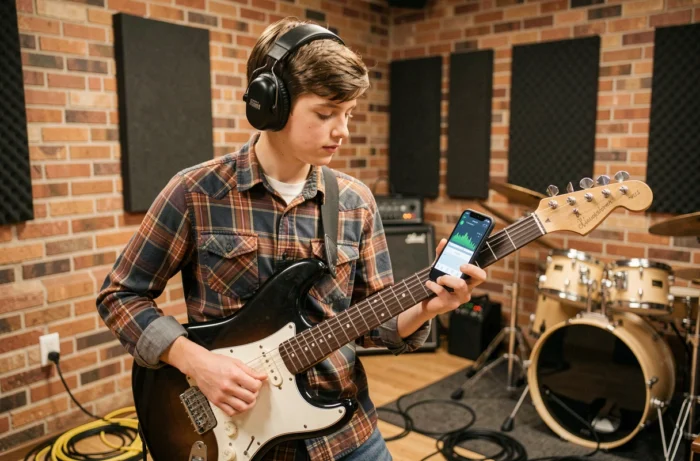
Sound level meter apps on phones are easy to access, but the built-in microphone on a smartphone does not have the precision of a dedicated device. According to NIOSH’s work on sound measurement app testing, an external microphone improves reliability, but does not replace a professional sound level meter or dosimeter for regulatory assessment.
For educational use with a young musician, a properly calibrated app provides a useful order of magnitude. There’s no need to aim for laboratory precision to understand that a drumming rehearsal exposes much more than an hour of acoustic piano.
Online decibel calculator
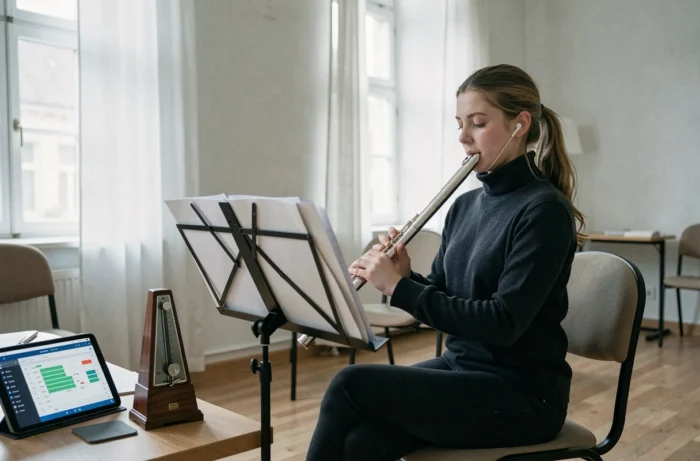
The calculator does not measure sound. It uses the levels you provide to calculate the total exposure dose and compare it to the recommended threshold. It’s a synthesis tool, not a sensor. Enter measured levels, not random estimates.
In practice, the most accessible combination for a household is to approximate the sound level with a mobile app during each activity, then enter these values into an online calculator.
Hearing protection suitable for musical practice
Reducing volume is not always possible: an orchestra plays at a certain level, a drummer cannot hit softer without changing their technique. Hearing protection then becomes the main lever.
Not all earplugs are suitable for a musician. Standard foam plugs attenuate higher frequencies more, which distorts the perceived sound. A young violinist who can no longer hear the harmonics of their instrument properly risks forcing or playing out of tune.
- Acoustic filter earplugs (sometimes called musician plugs) attenuate sound more uniformly across the spectrum, preserving musical quality while reducing overall level.
- Custom-molded plugs, made by an audiologist, offer better comfort during long rehearsals and consistent attenuation, tailored to the type of instrument.
- For younger musicians, passive noise-canceling headphones may be suitable during very loud concerts or ensemble classes, provided they do not interfere with playing posture.
The choice depends on the instrument, age, and context. A drummer needs more attenuation than a flutist. An eight-year-old will not wear the same device as a teenager in conservatory.
French decree on amplified sounds and limits for rehearsals
Decree No. 2017-1244 of August 7, 2017, regulates sound levels in places broadcasting amplified sounds. It sets volume ceilings, public information, the provision of hearing protection, and areas or periods for auditory rest.
These obligations apply to the venue, not the individual. The decree does not calculate the cumulative dose of a young musician throughout their day. A teenager may spend a rehearsal in a room compliant with the decree, then follow up with a concert and a listening session with headphones. Each environment may comply with regulations, but the sum of these exposures can exceed the risk threshold.
This is precisely the gap that the decibel calculator fills: it places venue regulations in the context of the musician’s entire day.
Establishing regular auditory monitoring
Noise-induced hearing loss is gradual and often painless. A young musician will not feel their hair cells deteriorating. The first signs (temporary tinnitus, a feeling of blocked ears after a rehearsal) are alerts not to be trivialized.
- Schedule an annual hearing assessment with an ENT specialist or audiologist, especially if musical practice exceeds several hours per week.
- Use the decibel calculator once a quarter to reassess daily dose, as musical activities evolve (new group, new instrument, added concerts).
- Keep track of episodes of tinnitus or auditory fatigue in a notebook to report to the healthcare professional.
Regular auditory monitoring detects a decline before it becomes irreversible. The more intense the musical practice, the more important this monitoring is.
Protecting a young musician’s hearing does not mean forbidding them from playing loudly. It involves a concrete measurement of what they receive in their ears, an honest calculation of their daily dose, and protections that respect sound quality. The decibel calculator makes this work accessible to any parent or teacher, without expensive equipment or technical expertise.