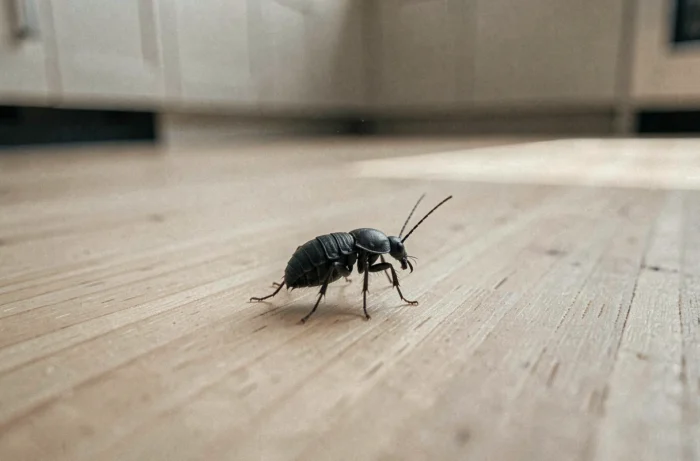
A small black arthropod jumps on the bathroom tiles or along a baseboard. The reflex is to think of fleas, but the diagnosis relies on two criteria that we detail here: the context of appearance (humidity, season, presence of animals) and the precise morphology of the observed organism.
Springtails, fleas, and psocids: quick identification keys
The majority of reports of “small black jumping creatures” indoors concern springtails (order Entognatha), not fleas. The most reliable discriminating criterion remains the moisture context: a specimen found near a shower joint, a houseplant pot, or a micro-leak under the sink indicates a springtail, whose cycle depends entirely on the residual moisture of the substrate.
The flea (Siphonaptera), on the other hand, primarily locates itself in the resting areas of the host animal: dog bed, carpet, sofa. We systematically observe grouped bites on the ankles or calves of the occupant in the case of a flea infestation. The absence of bites almost excludes the flea.
If you notice the recurring presence of a jumping black insect in the house, the third candidate to consider is the psocid (Psocoptera). This one does not jump in the strict sense but moves very quickly. It prefers closets, bookshelves, and rooms where the relative humidity exceeds the threshold favorable for the development of microscopic molds on which it feeds.
- Springtail: less than 2 mm, sudden jump thanks to the furca (ventral appendage), no damage to textiles or skin, strictly linked to humidity.
- Flea: 1.5 to 3 mm, laterally flattened body, jumps long distances, causes itching and skin lesions.
- Psocid: 1 to 2 mm, soft body, no visible wings in domestic species, rapid movement without true jumping, feeds on molds and organic glues.
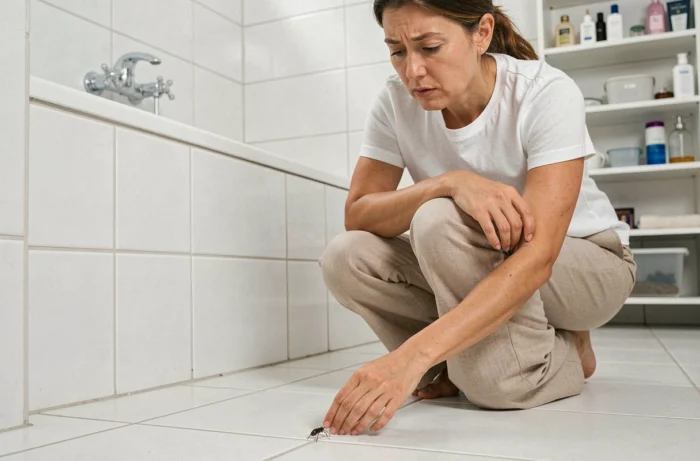
Residual humidity in buildings: the cause that insecticides do not solve
Chemically treating a problem of springtails or psocids is like wiping water under a leaking faucet. The primary cause is almost always an excess of humidity in the building. We recommend looking for the source before any biocidal intervention.
In new or recently renovated homes, construction moisture takes several months to dissipate. Springtails may appear in large numbers during this phase and then disappear spontaneously once the building is dry. A fresh coating, a concrete slab poured less than six months ago, or poorly ventilated drywall can concentrate enough water to sustain visible populations.
Priority control points
- Bathroom joints that are degraded or blackened, a sign of chronic percolation behind the tiles.
- Blocked or absent ventilation system: check the airflow by placing a sheet of paper in front of the extraction vent.
- Under-sink area and siphons: a micro-leak at the flexible connection maintains sufficient localized humidity.
- Baseboards in direct contact with an uninsulated slab (frequent capillary rises on the ground floor).
Correcting the source of humidity is sufficient in the vast majority of cases to permanently eliminate springtails. The insect has no survival capacity in a dry environment.
Fleabeetles indoors: the often-confused seasonal case
Another scenario that popular articles overlook: massive intrusion of flea beetles after a heatwave. These small black jumping beetles (family Chrysomelidae) normally live on crucifers in the garden. When temperatures rise sharply or a storm follows a drought, flea beetles migrate in large numbers to light-colored facades and enter through open windows.
The distinguishing feature compared to springtails is the rigid shell, visible under magnification, and the fact that the flea beetle can fly short distances in addition to jumping. It does not reproduce indoors and causes no damage to the building or the occupants.
Practical management of domestic flea beetles
No chemical treatment is justified. Vacuuming as needed remains the most effective method. Installing fine mesh screens on openings exposed to the south and west significantly reduces entries. The episode resolves within a few days as soon as weather conditions stabilize.
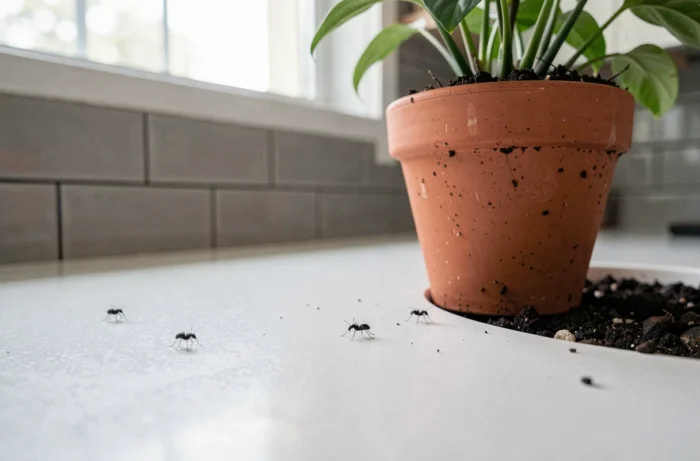
Elimination protocol according to the identified species
Once the identification is made, the treatment diverges radically from one species to another. Applying a broad-spectrum insecticide without diagnosis amounts to masking the problem.
Springtails and psocids
The only sustainable response is the control of hygrometry. Lowering the relative humidity below the critical threshold stops reproduction within a few weeks. An electric dehumidifier placed in the affected room accelerates the process in poorly ventilated homes. Additionally, removing decomposing organic materials (wet potting soil, wood stored indoors) eliminates the food source.
Fleas
The treatment requires a simultaneous dual action: treating the host animal with an appropriate antiparasitic (spot-on or tablet prescribed by a veterinarian) and treating the environment. Daily vacuuming of resting areas for at least three weeks targets larvae and cocoons, which resist contact insecticides. A growth regulator (IGR) applied to textiles prevents residual larvae from reaching the adult stage.
Confusing springtails and fleas leads to unnecessary, costly, and potentially harmful biocidal treatments for the occupants. Visual diagnosis combined with the humidity context and the presence or absence of bites remains the first technical gesture to take before any intervention.


