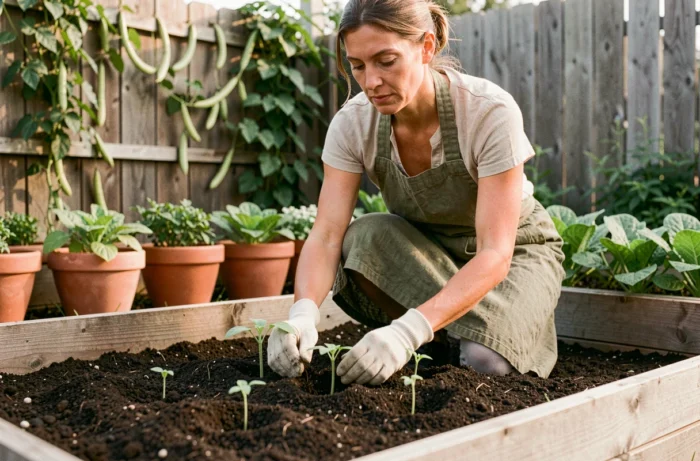
An organic vegetable garden that produces continuously is not just a matter of space or favorable climate. It is primarily about timing and living soil. Planning your sowing, nourishing the soil between crops, and choosing varieties suited to each season allows for harvesting fresh vegetables well beyond summer.
Crop rotation in the organic garden: the lever that the soil demands
We tend to replant tomatoes in the same spot each year because “it worked well there.” The problem arises in the third season: the plants yellow, yields drop, and diseases set in. Rotating on at least four plots breaks this cycle.
The principle is simple. We group vegetables by botanical family (Solanaceae, Cucurbitaceae, Fabaceae, Allium) and move them from one plot to another each year. Fabaceae (beans, peas, broad beans) fix atmospheric nitrogen in the soil through their root nodules. Placing nitrogen-hungry Solanaceae (tomatoes, peppers, eggplants) on the plot that hosted Fabaceae the previous season takes advantage of a natural fertilizer without buying anything.
A often overlooked point: Allium (garlic, onion, shallot) have a cleansing effect on the soil. Interspersing them after Cucurbitaceae sensitive to soil fungi helps limit fungal pressure. This provides, on the garden of L’Herbe sous le Pied, a concrete overview of this type of plot organization adapted to organic gardening.
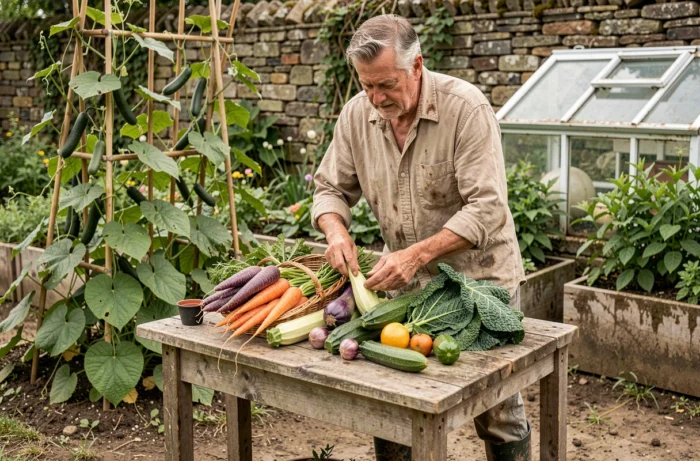
Staggered sowing and cold-resistant varieties: producing beyond summer
An organic garden all year round relies on staggered sowing. Sowing radishes or lettuce all at once guarantees a grouped harvest, then nothing for weeks. Spacing sowings by two to three weeks spreads out production and avoids waste.
For autumn and winter, certain varieties withstand low temperatures without heavy protection. Corn salad, winter spinach, kale, and leeks remain productive even after the first frosts. The sowing of these vegetables takes place between July and September, depending on the region.
- Corn salad: sowing in August-September, harvest from October to March. Resists frost well if the soil is well-drained.
- Winter spinach (type “Géant d’hiver”): sowing in September, harvest from November to February. Prefers a soil rich in compost.
- Kale: sowing in June-July, harvest from autumn through winter. The cold enhances its flavor by concentrating sugars in the leaves.
- Leek: sowing in spring, transplanting in June, harvest from autumn to the following spring. Easily withstands harsh winters.
Seeds of these varieties are easily found in organic. Checking for the mention “AB” or “untreated after harvest” on the packet ensures consistency with the garden’s approach.
Living soil and homemade compost: nourishing the soil without synthetic fertilizers
In an organic garden, soil fertility is built with organic matter, not with bags of fertilizer. Homemade compost remains the foundation. We put vegetable peels, coffee grounds, crushed eggshells, dead leaves, and dried grass clippings in it.
The balance between nitrogenous materials (green waste, fresh clippings, peels) and carbonaceous materials (dry leaves, brown cardboard, chipped branches) determines the speed of decomposition. Compost that is too rich in nitrogen smells bad and becomes slimy. Too much carbon, and decomposition stagnates for months.
A regulatory point deserves attention. Synthetic fertilizers for amateur gardeners will be gradually restricted in the coming years. Domestic gardens will need to rely more on compost, composted manures, and organic fertilizers compliant with European regulation 2019/1009 on fertilizers. Anticipating this transition means adopting a self-sufficient soil now.
Permanent mulching between rows
Mulching complements compost. A layer of straw, hay, or dried clippings between vegetable plants limits water evaporation, slows weed emergence, and nourishes earthworms as it decomposes. We mulch as soon as the soil warms up in spring, and we renew the layer when it thins out.
Feedback varies on the optimal thickness depending on regions and soil types. On clay soil, a layer that is too thick can retain excessive moisture and encourage slugs. On sandy soil that dries quickly, generous mulching can be done without fear.
Water management in the organic garden: water less but better
Water is often the most underestimated aspect of the garden. Watering every evening on the surface gives the impression of doing well, but the water evaporates before reaching the deep roots. A generous watering twice a week is better than light daily watering, as it forces the roots to go deeper to seek moisture.
Drip irrigation remains the most economical method. A porous hose laid at the base of the plants, under the mulch, delivers water directly to the root level. Water consumption decreases significantly compared to sprinkler irrigation.
- Water early in the morning to limit evaporation and reduce the risk of fungal diseases on the foliage.
- Collect rainwater in a tank: it is naturally soft, chlorine-free, and plants prefer it.
- Hoeing the surface of the soil before watering breaks the crust and improves water penetration.
Organic gardening all year round also requires reducing watering in autumn and winter. Winter vegetables (corn salad, leeks, cabbages) have much lower water needs than summer crops. Excess moisture during this time causes more damage than drought.
Adapting your actions to the rhythm of the seasons, maintaining a soil rich in organic matter, and choosing the right varieties at the right time: a productive organic garden all year round relies on these three pillars. The first concrete step is to plan your staggered sowings as early as the end of winter to never leave a plot empty.


