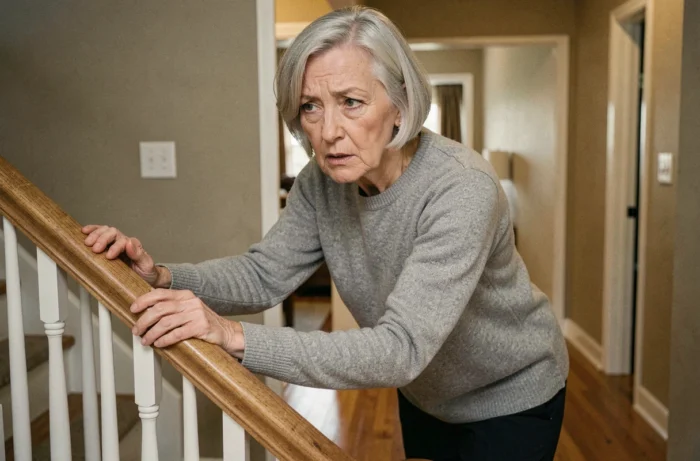
The vestibular system alone does not account for postural stability. When a patient describes a loss of balance, the clinical reflex often points to the inner ear, sometimes incorrectly. We observe that central neurological causes remain underexplored initially, even though they radically change management and prognosis.
Orthostatic hypotension and loss of balance: an underdiagnosed neurological cause
Neurogenic orthostatic hypotension is not limited to discomfort upon standing. Recent recommendations classify balance disorders with leg weakness and walking difficulties among the signals that should actively prompt the search for this pathology, particularly in patients with a neurological profile (Parkinsonian syndromes, autonomic neuropathies). Systematic screening in these populations changes the game.
In practice, a drop in blood pressure upon standing goes unnoticed if it is not measured within the first three minutes after standing up. Many patients labeled as “age-related instability” actually present treatable dysautonomia. The tilt-test remains underutilized in outpatient medicine, even though it leads to specific treatments (dosage adjustment, venous compression, midodrine).
We recommend considering this avenue as soon as a patient describes increased balance losses while standing for prolonged periods or after meals, even in the absence of rotational vertigo. The misleading presentation, as neurological disorders explained by Valbreon details, often delays diagnosis by several months.
Neurological red flags: when loss of balance without vertigo becomes an emergency

One point that popular articles rarely address with the necessary precision: a sudden change in gait or balance, even without vertigo, constitutes a possible neurological emergency. Compressive cervical myelopathy, brainstem stroke, vertebral artery dissection: these etiologies sometimes manifest solely as rapidly appearing ataxia.
Professional clinical guidelines identify specific red flags that should never be trivialized:
- Acute onset gait disturbance (from a few hours to a few days) associated with hand clumsiness or neck stiffness, pointing towards cervical myelopathy
- Postural instability with dysarthria, diplopia, or swallowing difficulties, suggestive of brainstem or cerebellar involvement
- Unilateral loss of balance with unusual headache, necessitating the exclusion of arterial dissection or an expansive process in the posterior fossa
- Fluctuating weakness of the lower limbs worsened by exertion, which may reveal myasthenia or a neuromuscular junction pathology
Each of these scenarios justifies urgent brain and spinal imaging. The time between the first symptom and the MRI directly influences functional prognosis.
Cerebellar involvement and Parkinsonian syndromes: distinguishing pathological gaits
The type of imbalance guides the neurologist. Cerebellar ataxia produces a staggering gait, with widening of the base of support and multidirectional oscillations. The patient cannot stand in tandem (one foot in front of the other). Coordination of the upper limbs is often impaired in parallel (dysmetria, adiadocokinesis).
Parkinsonian syndromes generate a different picture: shuffling gait with loss of arm swing and freezing. Postural instability typically appears with changes in direction and during turning. In Lewy body disease, these gait disturbances may precede cognitive signs by several years, making early diagnosis particularly challenging.

Leukoaraiosis (white matter damage of vascular origin) represents another common cause in seniors. It causes progressive imbalance with slowed gait, often attributed to normal aging. Brain MRI reveals hyperintensities in the white matter, the extent of which correlates with the severity of instability.
Loss of balance in children: pediatric neurological signals to know
Balance disorders are not limited to seniors. In children, delayed walking beyond 18 months or unexplained repeated falls necessitate a pediatric neurological evaluation. The etiologies differ radically from those in adults: posterior fossa tumors, hereditary ataxias, metabolic diseases.
A sudden onset of instability in a febrile child should also raise suspicion of meningitis or encephalitis, conditions where balance disturbances accompany associated neurological signs (neck stiffness, altered consciousness). Urgent diagnosis is crucial for vital prognosis.
The pediatric neurological examination assesses standing, walking in a line, oculomotor coordination, and deep tendon reflexes. A clear asymmetry or regression in motor skills points towards a central lesion requiring immediate imaging.
Neurological assessment of loss of balance: prioritizing examinations
In the face of chronic instability without an obvious vestibular cause, we recommend structuring the assessment in two stages. The first relies on a complete neurological clinical examination (evaluation of tone, reflexes, deep sensitivity, Romberg test, cerebellar tests). The second involves targeted imaging.
Brain and spinal MRI remains the reference examination to identify a central lesion, myelopathy, or leukoaraiosis. Electromyography complements the assessment when peripheral neuropathy is suspected (loss of proprioceptive sensitivity in the feet, abolition of Achilles reflexes).
Videonystagmography and vestibular evoked potentials do not replace the neurological assessment: they explore the peripheral side. Persistent loss of balance despite well-conducted vestibular rehabilitation should always prompt reconsideration of a central origin. The most common pitfall is to stop at a peripheral vestibular diagnosis when the clinical picture points to the brain.


