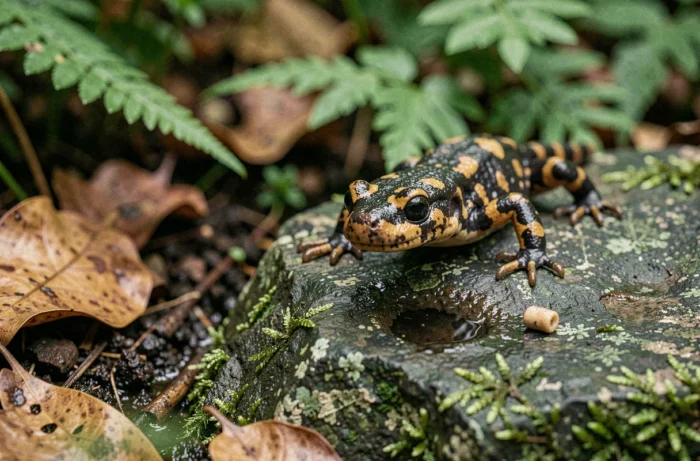
During a walk in a humid forest, you come across a small dark deposit on a dead leaf or a mossy stone. The temptation is strong to attribute it to a mammal, but it could come from a discreet amphibian: the spotted salamander.
Identifying amphibian feces in a forest environment requires a different method than that used for fox or badger droppings, because their size, consistency, and lifespan on the ground are not comparable.
Why salamander feces are difficult to identify visually
In mammals, the shape of a dropping remains fairly stable from one individual to another within the same species. In amphibians, the situation is more complex. The appearance of the droppings varies according to the current diet (worms, slugs, small beetles), ambient humidity, and the nature of the substrate on which they settle.
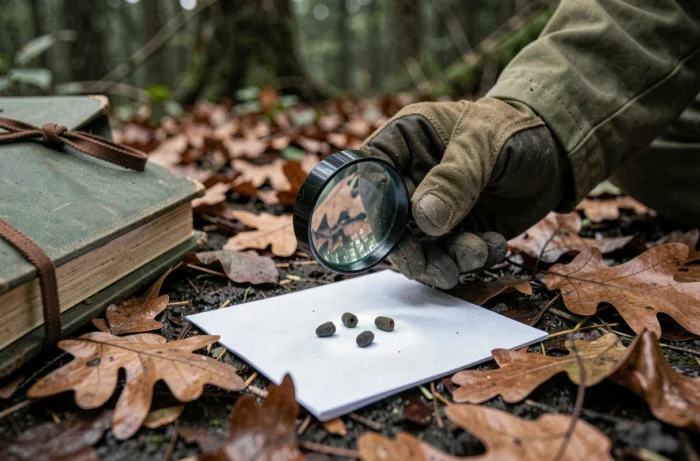
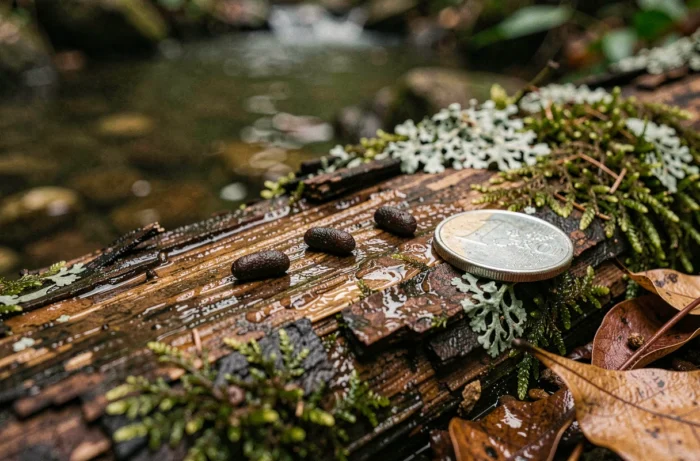
In practice, a spotted salamander dropping appears as a small blackish clump, often less than a centimeter, moist and poorly structured. It quickly blends in with a fragment of soil, a piece of decomposed leaf, or the droppings of a large invertebrate. After a few hours of rain, it is nearly invisible.
This is why visual identification alone is not enough to confirm the presence of salamanders. Even an experienced naturalist must cross-reference several clues before concluding. Observing salamander droppings in nature is a first step, but the continuation of the investigation relies on the surrounding context.
Field clues to confirm the presence of salamanders
Have you spotted a suspicious deposit on a flat stone or a fallen trunk? Before trying to analyze the dropping itself, look around you. The spotted salamander frequents very characteristic micro-habitats, and their presence validates (or invalidates) your hypothesis much better than the shape of the dropping.
Discovery context to verify
- Immediate proximity to a stagnant water point or a slow-flowing stream, necessary for the species’ reproduction.
- Thick, moist forest litter composed of broadleaf trees (beech, oak), providing shelters under stones, logs, and bark.
- Absence of direct light at the time of discovery: the salamander is active at night or during rainy weather, and its traces are rarely found in exposed terrain.
- Mild temperature and high humidity, typically between early autumn and spring.
If three or four of these criteria are met, the probability of salamander presence increases significantly. Conversely, a deposit found in an open dry field, far from any wooded area, points to another animal.
Environmental DNA: the method that replaces the magnifying glass
Have you ever noticed that professional naturalists sometimes collect water from a stream using a simple sterile bottle? This action corresponds to an environmental DNA (eDNA) protocol. Amphibians, while moving, breathing through their skin, or defecating, release fragments of DNA into their environment.
These fragments can be collected from the water and then analyzed in the laboratory to determine which species frequent the watercourse. eDNA allows for the detection of a species without capturing or disturbing a single individual. The method has already confirmed the presence of rare salamanders in areas where visual observations were unsuccessful.
What eDNA does not tell
A positive result confirms that a species has recently frequented the environment. It does not directly inform about the number of individuals. The concentration of DNA in the water depends on the flow rate, dilution, and the time elapsed since the animal’s passage.
In other words, eDNA detects presence but not abundance. To estimate population size, other protocols (night counts, monitoring of egg-laying) remain necessary.
Spotted salamander and forest biodiversity: what its presence reveals
The spotted salamander (Salamandra salamandra) is a recognized bio-indicator of the quality of humid forest environments. Its permeable skin makes it vulnerable to chemical pollution, pesticides, and drying out. When it is present in a woodland, it signals a functional ecosystem: living soil, intact water network, sufficient vegetation cover.
Searching for its traces, including its feces, is therefore part of a broader approach to assessing local biodiversity. An inventory that combines visual spotting of droppings, nocturnal observation, and eDNA sampling would produce a much more reliable diagnosis than any one of these methods in isolation.
Connecting the clues
A fragment of snail shell in a suspicious feces, combined with the discovery of a refuge under a flat stone in a moist beech forest, points towards the salamander. The same feces found in a dry stone wall in a Mediterranean area points more towards a gecko or a lizard.
The ecological context always takes precedence over the morphology of the dropping. Each clue taken in isolation remains ambiguous. Their intersection builds a solid hypothesis.
The next time you walk through a thicket after an autumn rain, carefully turn over a mossy stone (then replace it). If you spot a salamander or its traces, you will know that this forest harbors a functioning ecological network, from the soil to the canopy.


